Photo products are a significant aspect to consider when trying to convince people to buy your products. Online shopping is growing rapidly, especially during the pandemic. Not only can you find almost everything you need with a simple search, but online shopping is time-efficient and often economical. The power of an image is hard to ignore, and if you’re not including exceptional images of your products, then you could be losing out on many good sales. Regardless of who your customers are or what you are selling, a high-quality product photography business is a vital asset that contributes to your overall branding and success.
According to research from ViSenze, 62% of Gen Z and Millennial consumers want visual search capabilities. Pinterest CEO Ben Silbermann says, “The future of search will be about pictures rather than keywords.” Instead of searching for words, users can drag or snap a photo of clothes, furniture, or home decor without having to describe what they are looking for in a search box using Google Lens.
Are you ready to dive into the world of product photography business? Let us start with a simple definition.
What is Product Photography?
Product photography is a type of commercial photography designed to showcase a product as effectively as possible. Product photography requires a photographer’s creativity to ensure that products are presented memorably.
A well-crafted product photo portfolio will attract people more quickly and draw in the right audience. Let us start by utilizing some basic online assets. Product photographs are more than pictures on display.
There are other ways to make the photos engaging, the sales stand out, and convert customers to purchase products. For example, if you are an eco-friendly product, you can opt for colours and backgrounds that feature natural elements, such as wood or plants.
Here are five key reasons why a product photography business is essential. Check it out!
Why is Product Photography Business Important?
1. Your Photo Represents Your Brand

Low-quality, unprofessional photos on your website or social media will communicate the same about your organization and the products and services you offer. Your photos and website are crucial in making a strong first impression on customers. They can be used to build your brand on social media, including Facebook, Instagram, Twitter, Pinterest, LinkedIn, and more.
2. Photo Products are Linked to Your SEO

The images on your website, including photo products, can contribute to your SEO. Optimizing your product images and photos for search engines is a great way to gain interested customers for your products. No matter how amazing your products are, taking compelling photos of your products is critical to success. You must bear in mind that buyers cannot physically touch or hold your products; they only have the images to go by.
3. Make the Most of Your Marketing Strategies

Quality product photography businesses do more than sell products and represent your brand. They can help to expand your reach and bring in new audiences. For starters, photos can be used across multiple platforms, creating a consistent messaging experience on your website, in advertising, and on social media accounts. Good photos can increase engagement and sharing, essentially crowdsourcing your marketing efforts. This level of audience participation can expand your reach without any additional effort or expense on your part.
Read also: 4 Digital Marketing Trends Forecast for 2021
4. Building The Uniqueness of Your Brand
76% of product photos are on white backgrounds. This means that if you’re looking to build a unique brand, there’s room to incorporate bright colors, prints, or lifestyle settings to display your products attractively and excitingly. Just remember, if you want to sell on marketplaces, white labeling is unavoidable. In Dropicts, with Retouch Background Services, we offer professional photo retouching services that can enhance the attractiveness and quality of your photos.
5. Choosing the Product Photographer

Look for a photographer who is happy to show you plenty of examples of their previous work; this will give you an idea of their capabilities. You might also consider a company that offers 360-degree photography, as this will allow you to showcase your products to their full advantage. Sometimes, there is an issue of finding the right one for your requirements. Whether you can hire a third party, such as a photographer, agency, or product image editing services, you should know what’s best for your brand and choose wisely.
Good product photography can mean the difference between that potential customer choosing your product or one from a competitor, and if you think that hiring a product photography business or using professional photo editing services is too expensive, you are going in the wrong direction; this can save you money in the long run. Ensure the images are blur-, noise-, and pixelation-free. So, never underestimate the power of a good photographer’s work in enhancing your product photography business.
What Equipment Do I Need to Take High-Quality Images?
Product photography business often occurs inside the studio. Some equipment can make the difference between a mediocre photograph and a memorable one. Ideally, it is a studio strobe that aims to provide a softer shadow than natural light does. With a tripod, you can frame an image the way you like with varying angles. Background can be seamless paper, tile, painted plywood, textured wallpaper, or fabric. There are many choices, so you can get creative with what you use. The plinth and riser can be made of either wood or acrylic and are quite handy when trying to provide precise dimensions.
Camera
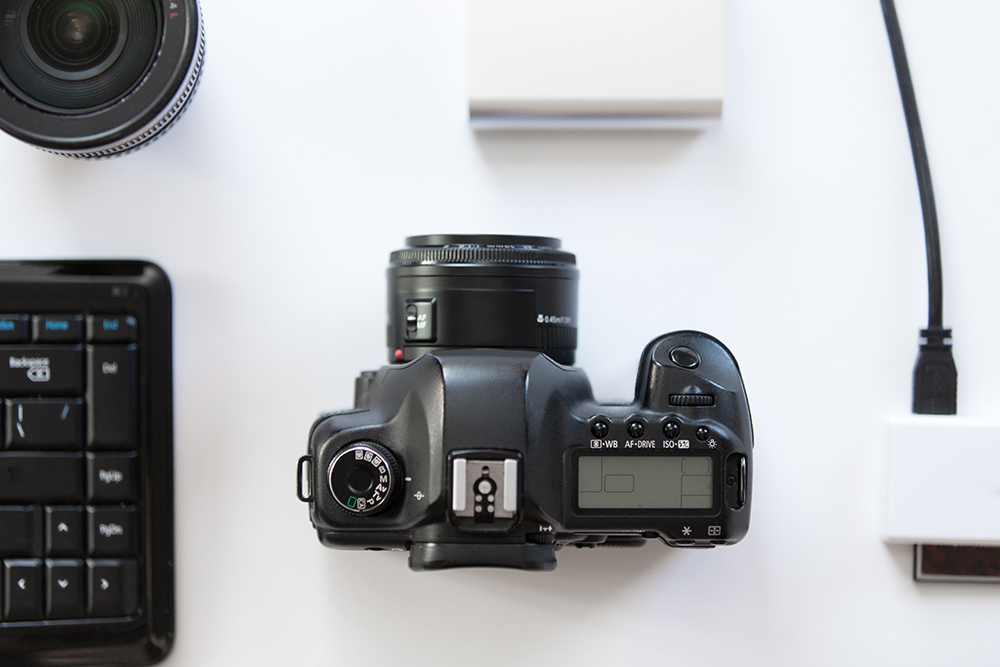
Some of the Top Professional Photographers have a high-end camera that can be purchased for approximately $ 1,500-$4,999 USD. Many of them rent on-site. It doesn’t matter if you’ve got a very advanced camera for a successful filming business. The artwork must differentiate you from other photographers. But you still need a camera that has some very important features.
Find and Use The Right Lenses
It is sufficient to buy some standard 20-54 mm kits on most devices. If you want to film an object less than one inch wide, consider investing in a macro lens. For electronic commerce or a catalogue, such levels of detail and clarity are sufficient.
Grip Equipment
All these kinds of equipment require grip equipment. For example, a 5-in-1 reflector that bounces light in a dark area. Another essential piece of equipment is the C-stand, also known as a light stand with an extended arm. When you take a top-down shot, it is not possible to hold the camera in this position. The camera stands on a light stand to protect it from sunlight.
Backdrops
The following essential item is the product background. A photo shoot can’t start without a properly set-up background. You need more than a single backdrop. It’s very easy to begin with a white background for your business.
Reflectors
Reflectors are used to reflect light. This might not be necessary depending on the type of product you’re filming. For reflective devices like glass or metal, it is helpful to minimise reflections and control light.
Light stands
LED sticks can serve as a good tool to support lighting. If you get one from a lighter-weight manufacturer, ensure that it is light enough to be carried with you during photos if needed. For stacking lighter modifiers and boom arms, you need a support system that can handle the weight. Ensure the stand is sturdy enough.
Tripod
When using products, it is essential to adjust the height so that the device is easy to use and less intrusive. Another useful tripod characteristic is a horizontal arm. It also allows shooting from the overhead – something that’s usually done for product photography. If you want to get a closer picture of larger sections of this image, consider using a macro lens.
Product Photography Business Tips
In studio with white backdrop
About 95% of garment designers have photos surrounded by a simple white background. Cosmetic and beauty brands most likely use white backgrounds. This allows customers to see what they get and know what they want. By eliminating visual barriers, the characteristics of a product can be highlighted with a white backing for product-only photographs.
For example, consider how brands can create online product catalogs with product images to highlight their features. The best part of using a white background is that it lets you highlight a product with minimal distortion and distraction.
Scale photos
For many products, showcasing the size is a significant marketing point. When taking photos at scale, it is essential to consider your needs and decide whether you want the scale to be explicitly conveyed or by using another object in the frame.
Learn the basics of image making
Automatic mode is over. Learn about the Exposure Triangle – Aperture, how shutter speeds and ISO affect images. How should a photograph be viewed? Discover the principles of composition and what makes pictures more visually appealing.
Understand lighting fundamentals
Lighting is a critical part of the product photography business. The light defines your product photography business, whether professional or amateur. How does light function? How do they fall, and how do they respond to their opponent? Learn to light, so you’re aware of what’s not lit.
This crucial element separates the high-quality results from the average product photography results. Even if you are a beginner, this post shows you how to light a product photo with minimal lighting. Start from here, and then start adding further lighting at some point.
Learn how to edit product photos efficiently
You’d need a professional in Photoshop. Learn colour managers and maintain consistent colours in every image of their respective series. Some of the product photos require compositing, so learn about them as well.
Set up your studio
When it’s time to start your studio, the location will require ample space for your movements. The area should have large spaces with lighting stations and tables, as well as a table for displaying various products. You could use your garage, the small living area, or the small storage area. It should have plenty of ventilation. The space you choose is the installation location. If you’re taking photos with small equipment on a table, it’s okay. Or, you can buy the lit tent.
Keep it clean
The one drawback to taking sharp, detailed images of objects on a white background is that sharp detail includes bits of dirt and debris, as well as all the nooks and crannies covered in dust. A handy clone stamp tool in Photoshop can help solve imperfections in your picture. Please avoid using this trick excessively, as it can be time-consuming and compromise the quality of your product photography business.
Learn the craft thoroughly
The product photography business is a patience game. You must constantly develop an image before it meets your expectations. Even minor details matter.
Every professional product photographer starts small. You can still learn and improve yourself with minimal equipment; do not wait until you have all the tools you need to start learning!
That’s a brief explanation about the product photography business. Don’t forget to elevate your product photography business by using product image editing services and professional photo retouching services, all available at Dropicts.